-
 Turn page

Camping or not?
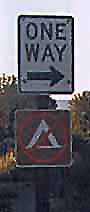 Imagine that you are at the Grand Canyon
on summer vacation. The sun is setting and you
are looking for a place to camp for the night.
You turn off the main road and see a sign ahead.
Below the "One Way" sign there is another small sign
with a picture of a tent. Ah! Camping is permitted
here.
Imagine that you are at the Grand Canyon
on summer vacation. The sun is setting and you
are looking for a place to camp for the night.
You turn off the main road and see a sign ahead.
Below the "One Way" sign there is another small sign
with a picture of a tent. Ah! Camping is permitted
here.
But wait! As you get closer you see what looks like a "Do Not" circle on the small sign. You shine the car's headlights toward the small sign. (See picture below.) Oh! camping is NOT permitted here.
 The
red "Do Not" circle is easy
to see during the day because red is highly
visible under bright light. However, after the sun
has set, your eyes begin to adapt to the
darkness. As this
happens the subjective brightness of red decreases
in comparison to other colors. This phenomenon,
called the Purkinje shift, makes it more
difficult to see the red "Do Not" circle, especially
on a brown background, because there is little
contrast.
The fact that this small
sign is difficult to read in low light conditions
is ironic since those are likely
conditions under which people are looking
for a place to camp.
The
red "Do Not" circle is easy
to see during the day because red is highly
visible under bright light. However, after the sun
has set, your eyes begin to adapt to the
darkness. As this
happens the subjective brightness of red decreases
in comparison to other colors. This phenomenon,
called the Purkinje shift, makes it more
difficult to see the red "Do Not" circle, especially
on a brown background, because there is little
contrast.
The fact that this small
sign is difficult to read in low light conditions
is ironic since those are likely
conditions under which people are looking
for a place to camp.
Design suggestion
Changing the background color to white and the picture of the tent to black would increase the contrast of the "Do Not" circle and make it much easier to see in low light conditions.Suggested reading
This book describes the Purkinje shift and other perceptual phenomena in an easy-to-understand style:Foley, H. J. and Matlin, M. W. (2009). Sensation and Perception. Needham Heights, MA: Allyn and Bacon.
Turn page
Copyright © Michael J. Darnell 1999-2010. All rights reserved.
 Table of contents
 Home page